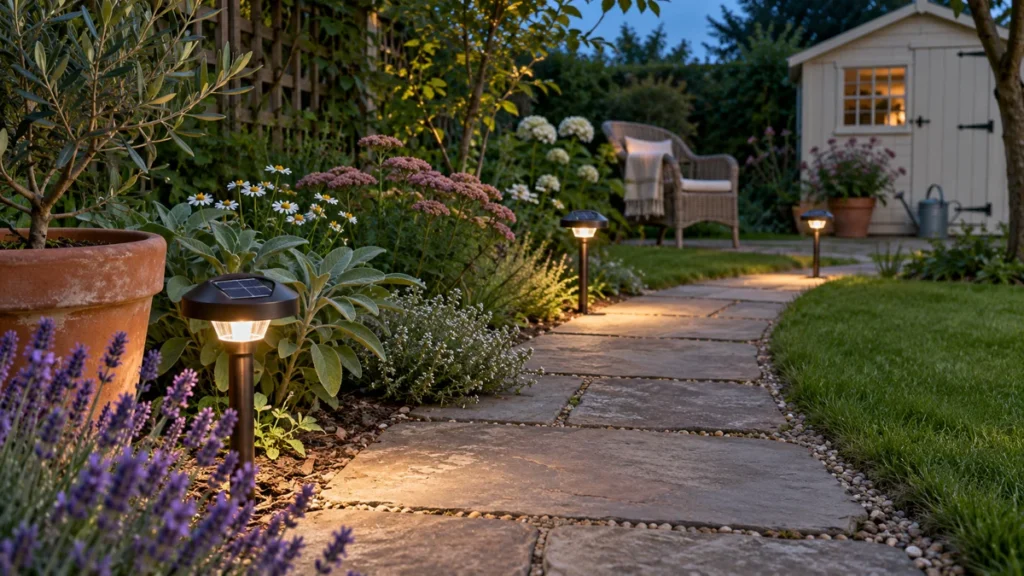
Solar garden lights work best when the panel gets reliable daylight and the light has a modest, clearly defined job. Marking a path or adding a warm glow to a seating area is different from illuminating steps safely all night. Choose for the job first, then check the charging location, battery serviceability and outdoor rating.
A lovely product photo does not tell you how the light performs after a cloudy day. This guide is a practical buying and troubleshooting checklist, not a product ranking. Start with a small trial in your own garden before ordering enough lights for the whole space.
Choose the light by the job it needs to do
| Type | Useful for | Check before buying |
|---|---|---|
| Path light | Showing the edge and direction of a path. | Does light reach the paving, or mainly shine into your eyes? |
| String lights | Atmosphere over a seating area or along a boundary. | Outdoor suitability, support points and a sunny place for the separate panel. |
| Lantern | A movable pool of decorative light on a table or patio. | Whether the panel can charge where the lantern will sit. |
| Spotlight | Highlighting one plant, sign or garden feature. | Aim, panel placement and usable brightness over the required hours. |
| Motion light | Brief illumination when movement is detected. | Detection area, activation settings and battery recovery after frequent use. |
Decorative lighting should not be your only provision where losing light creates a hazard. If a step, access route or entrance must stay reliably lit, consider a professionally designed wired solution or another suitable dependable system. Extra solar lights do not solve an inadequate charging location.
Find the panel position before choosing the light position
Watch the proposed panel location in the morning, around midday and later in the day. A spot that looks bright from the kitchen may sit under a roof edge or tree shadow for most of its charging window. A panel needs useful solar exposure; the fact that you can comfortably read a book there is not proof of adequate charging.
Separate-panel lights let you place the lamp where it is useful and the panel where there is more sun. Check cable length, the permitted mounting arrangement and whether the route avoids a trip hazard. An integrated panel is simpler, but moving the light into deep shade also moves its charging source into shade.
Think beyond the installation day. Leaves grow, neighboring structures cast different seasonal shadows, and the winter sun follows a lower path. Our solar tilt-angle calculator can help explain orientation, but a small garden light’s own mounting instructions and local shade still determine its practical placement.
How long should solar lights run at night?
There is no honest universal runtime. It depends on energy stored by dusk, battery condition, light output, control mode and weather. A summer “up to” rating is not a winter guarantee. Manufacturer Lights4fun specifically notes that shorter winter days can mean shorter illumination; read the conditions attached to the exact model’s claim.
Worked example, not a product specification: suppose a small light has 3Wh of energy available for the night and its lighting plus control electronics draw an average 0.5W. The simple runtime is 3 ÷ 0.5 = 6 hours. If a cloudy day leaves only 1Wh available, the same load lasts about 2 hours. If its mode dims automatically, brightness and runtime both change.
Battery labels sometimes show milliamp-hours rather than watt-hours. To compare nominal energy, multiply voltage by amp-hours: an illustrative 1.2V, 2,000mAh battery is 1.2 × 2 = 2.4Wh nominally. Usable energy can be lower. You cannot compare batteries by mAh alone when their voltages differ, or substitute a different chemistry because it physically fits.
A simple three-night trial
Keep the packaging and check the return conditions. Follow the initial charging instructions, remove any shipping tab if instructed and select one fixed operating mode. Record the weather, panel location, switch-on time and the time the light becomes too dim for its intended job. “Still faintly glowing” is not the same as useful illumination.
Repeat after a sunny day and a cloudier day without changing several things at once. If performance improves markedly when the panel moves into a clearer location, the site is part of the problem. If you need the light until a particular hour, judge it against that requirement rather than against a sales photograph.
Why solar lights stop working—or only last briefly
| Symptom | First check | Next step |
|---|---|---|
| No light at all | Shipping tab, switch, selected mode and initial charge instructions. | Follow the manual’s darkness test; some sensors will not activate in daylight. |
| Works in another location | Shade, dirty panel or a nearby lamp confusing the daylight sensor. | Change one placement factor and repeat the trial. |
| Starts bright, fades early | Charge received that day and selected brightness. | Compare after proper charging before assuming the battery has failed. |
| One light fails in a matching set | Inspect accessible parts for damage or moisture without defeating seals. | Use the warranty or manufacturer troubleshooting procedure. |
| Older light has shorter runtime | Battery aging and panel cleanliness. | Replace only with the manufacturer-approved rechargeable type if user replacement is permitted. |
Stop using a unit with damaged wiring, a leaking or swollen battery, or obvious water damage. Do not attempt to charge a non-rechargeable battery in a solar light. If the battery is sealed inside, opening the housing may damage its weather protection; ask the supplier about repair or recycling instead.
What to look for before spending
Ask for the outdoor exposure rating, operating-temperature limits, battery replacement instructions and availability of spare parts. “Waterproof” is too vague on its own: a product suited to ordinary rain is not necessarily intended to be submerged or left where water pools. Check whether connectors and the separate panel share the required protection.
Read the warranty and return terms, especially for an integrated battery. Look for an actual lumen specification and the mode in which it applies, but do not compare brightness using a photograph alone. Beam direction, glare and contrast affect usefulness as much as the headline number. No verified specification means no reliable numerical comparison.
Keep the garden comfortable after dark
Aim light at the task, away from bedrooms and neighboring windows. Use a lower output or shorter schedule when that meets your needs. Keep panels clean using the maker’s instructions and inspect placement as plants grow. Let the night remain dark beyond the area you use; more light is not automatically a better garden.
At the start of spring, re-check stored lights, battery condition and switching instructions before putting them outside. If performance disappoints, test one unit and one location first. Replacing an entire set without diagnosing shade can leave you with the same problem and a second purchase.
The short version
Buy for a specific lighting task, give the panel a credible charging position and test useful runtime in your own weather. Replaceable approved batteries and clear outdoor instructions matter more than an ambitious all-night claim.
Sources reviewed November 14, 2026: Lights4fun solar lighting FAQ; manufacturer troubleshooting guidance; DOE solar-lighting energy considerations. Brand guidance applies to its products; always follow your own model’s manual. The energy example is illustrative.
Discussion