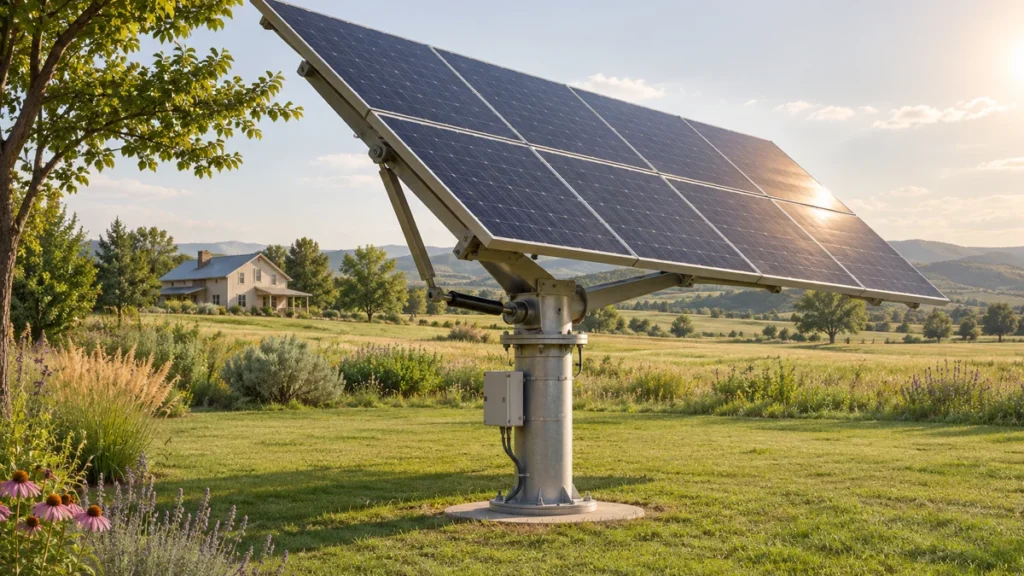
A solar tracker can increase energy production by turning panels toward the sun, but more kWh does not automatically mean a better investment. For a home, compare the tracker’s additional installed and maintenance costs with the value of the extra electricity. Also price a simpler alternative: more fixed panels, if space and connection limits allow.
Fixed, single-axis and dual-axis: the practical difference
| Arrangement | Movement | Main trade-off |
|---|---|---|
| Fixed panels | Stay at the selected orientation and tilt. | Simpler mounting; output follows the sun’s changing angle. |
| Single-axis tracker | Rotates around one axis. | More mechanical and control equipment; site design affects the gain. |
| Dual-axis tracker | Adjusts orientation on two axes. | More freedom to follow the sun; more moving equipment and site requirements. |
A tracker is not the same as an MPPT charge controller. MPPT adjusts an electrical operating point; tracking physically moves the array. A fixed solar array can use MPPT without any moving panels. See our solar system diagram guide for that electrical distinction.
How much extra output should you expect?
AllEarth Renewables advertises up to 40% more energy than a fixed roof system for its dual-axis tracker. This is the manufacturer’s claim and comparison, not a guaranteed gain for your property or every tracker. The roof baseline matters: a shaded or poorly oriented roof is not the same comparison as a well-designed fixed ground array.
Ask for two location-specific production models using the same panel capacity and clearly stated assumptions. Keep weather data, shading, inverter capacity and losses consistent where appropriate. Compare monthly and hourly production, not just one annual percentage. A gain during hours when you export cheaply may be worth less than a smaller gain when your household is using electricity.
PVWatts supports different array configurations, making it useful for an initial comparison. It is not a substitute for a site survey, structural design or a tracker-specific production guarantee. Our PVWatts comparison guide explains why weather and model assumptions need to stay visible.
Worked example: what is the extra energy worth?
Assume a fixed proposal produces 6,000kWh a year and the tracker proposal produces 7,500kWh. The modeled increment is 1,500kWh, or 25%. These are hypothetical proposal values, not a forecast for your property.
If 60% of that extra energy displaces electricity at an assumed $0.18/kWh, its value is 900 × $0.18 = $162. If the remaining 600kWh earns an assumed $0.06/kWh export payment, it adds $36. Total incremental value is $198 per year, before added maintenance, auxiliary consumption, downtime or financing.
If the tracker costs an additional hypothetical $3,000, simple payback on that difference is $3,000 ÷ $198 = 15.2 years before those costs. An extra $60 annual service allowance would reduce the modeled benefit to $138 and extend simple payback to about 21.7 years. These inputs illustrate the method; obtain actual prices, export rules and maintenance expectations.
Check the land, wind and service plan
A moving array needs clearance through its full travel, not only the position shown in a brochure. Ask about foundations, access, setbacks, underground services, shading and the effect on how you use the yard. Ground conditions and trenching can materially change installed cost.
Find out how the tracker handles strong wind, snow, loss of power and control faults. Ask what position it takes when it cannot track and whether it still produces energy. Require the relevant site-specific design ratings and the manufacturer’s instructions rather than assuming that all trackers share one wind limit.
The service question is concrete: who repairs the drive or controller, how far away are they, what parts are stocked, and what does labor cost after warranty? Compare warranties for the panels, structure and moving components separately. A long panel warranty does not automatically cover the tracking mechanism.
When each option deserves a closer look
| Your situation | Useful next comparison |
|---|---|
| Roof is unsuitable but open land is available | Fixed ground mount versus tracker, including foundations and access. |
| Limited budget and room for more modules | Additional fixed panel capacity versus tracking premium. |
| Valuable morning/evening production | Hourly production against actual import and export tariffs. |
| Little access to specialist service | Maintenance availability and downtime risk before paying for moving parts. |
Do not spend on tracking to solve a different bottleneck. Inverter clipping, an export limit, battery charging limits or shade may prevent some extra generation from becoming useful energy. Ask the installer to show the complete system constraint, including any proposed battery, rather than comparing panel output in isolation.
The short version
Choose tracking only when its location-specific extra energy and service plan justify its extra cost. Get a fixed-array alternative, value self-consumed and exported energy separately, and keep manufacturer output claims separate from your own forecast.
References reviewed November 14, 2026: AllEarth manufacturer tracker claim; PVWatts; System Advisor Model documentation. The featured image is conceptual, not a photograph of a reviewed product. No financial outcome is guaranteed.
Discussion